January 24, 2025

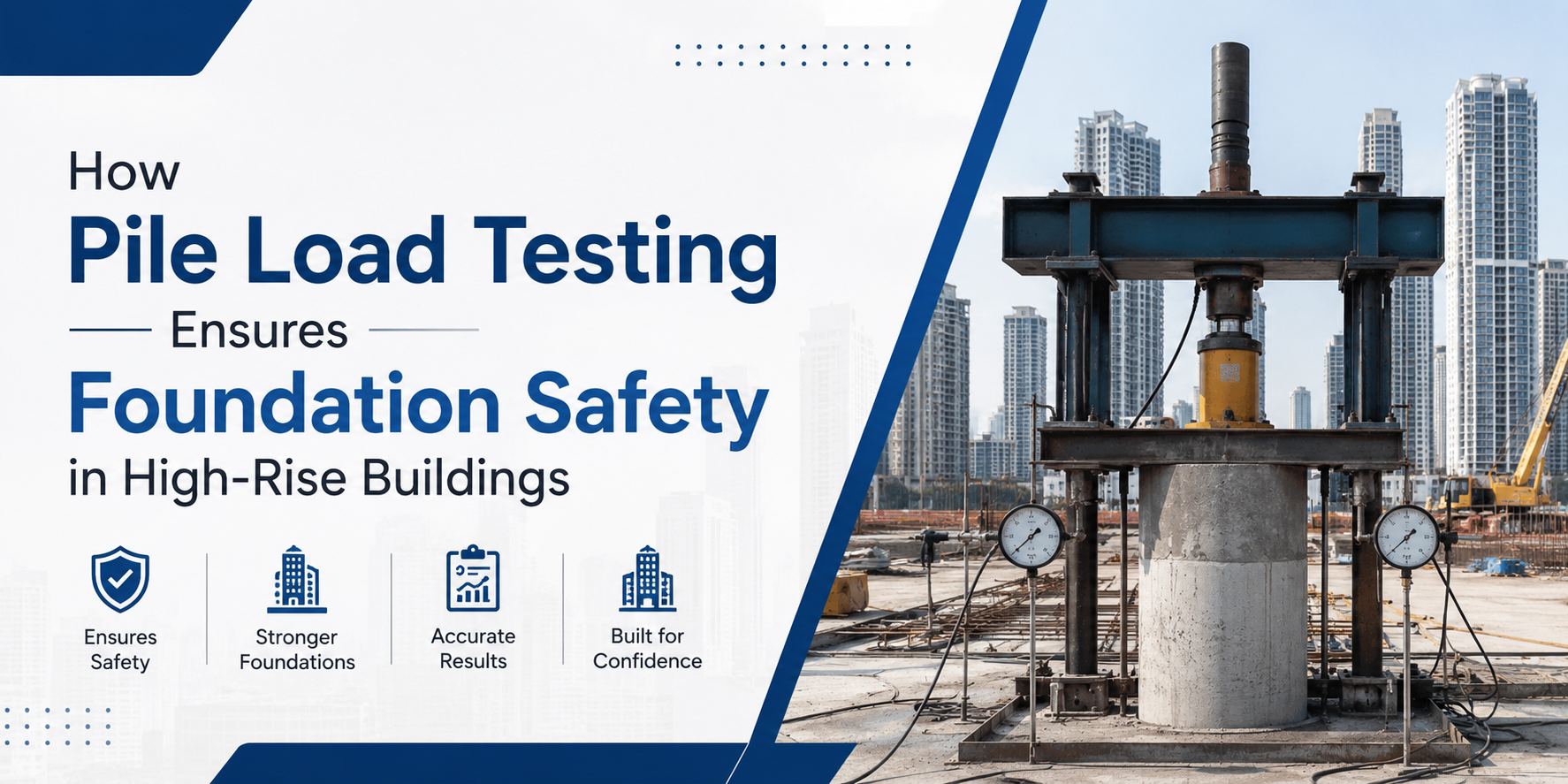
How Pile Load Testing Ensures Foundation Safety in High-Rise Buildings
When it comes to constructing high-rise buildings, the foundation is not just the starting point — it is the most critical element that determines the entire structure's safety and longevity. Among all geotechnical engineering techniques used today, pile load testing stands out as the most reliable method to verify that deep foundations can carry the intended loads safely.
Whether you are an engineer conducting a geotechnical investigation for construction, a developer planning a multi-storey project, or a contractor looking for pile load testing services near me, this comprehensive guide covers everything you need to know — from test types and methods to pile load testing cost in India.
What Is Pile Load Testing?
Pile load testing is a field-based geotechnical procedure that measures the actual load-bearing capacity and settlement behavior of a driven or bored pile under controlled loading conditions. It is an essential step in pile foundation design for buildings, bridges, and infrastructure projects.
Unlike theoretical calculations based on soil reports alone, a pile load test provides real, site-specific data that directly validates or refines the design assumptions. This on-ground verification is what makes pile load testing indispensable in modern deep foundation engineering.
Why Pile Load Testing Is Critical for High-Rise Buildings
High-rise buildings impose enormous vertical and lateral forces on their foundations. A single pile must often carry hundreds of tonnes of load transferred from columns, shear walls, and raft systems. Without rigorous testing, even small errors in geotechnical assumptions can lead to uneven settlement, structural cracking, or in extreme cases — catastrophic failure.
Pile load testing ensures foundation safety in high rise buildings by:
-
Confirming the actual pile load bearing capacity matches design requirements
-
Identifying any deficiencies in construction quality or pile installation
-
Providing data for pile settlement analysis to predict long-term building performance
-
Satisfying regulatory, insurance, and code compliance requirements
-
Reducing over-design and therefore overall project cost
Types of Pile Load Tests
There are several methods employed in modern pile load testing. The right test depends on the pile type, project size, available time, and budget.
1. Static Pile Load Test
The static pile load test is the most traditional and widely recognized method. In this test, a physical load — typically using kentledge (dead weight) or anchored reaction systems — is applied incrementally to the pile head. Dial gauges and load cells record the pile's response at each load increment.
There are three primary variants of the static test:
-
Compression (Vertical Load Test Pile): Applies downward axial load to measure compressive resistance — the most common type for building columns.
-
Tension/Pull-Out Test: Evaluates the pile's ability to resist upward forces, critical for structures in flood-prone or wind-heavy zones.
-
Lateral Load Test: Assesses resistance to horizontal forces, important for piles near retaining walls or in seismic zones.
Static pile load test results are highly accurate and remain the gold standard against which all other methods are benchmarked. However, the test can take several days to weeks and requires significant logistical setup.
2. Dynamic Pile Load Testing (High Strain Dynamic Testing)
Dynamic pile load testing, also called the High Strain Dynamic Test, uses a large instrumented hammer blow to the pile head. Sensors — strain gauges and accelerometers — are attached to the pile to capture force and velocity data in real time. This data is then analyzed using the CAPWAP (Case Pile Wave Analysis Program) to derive bearing capacity.
Key advantages of dynamic pile load testing include:
-
Speed: A single pile can be tested in minutes
-
Cost-effectiveness: Multiple piles can be tested in a single day
-
Suitability for production pile verification across large sites
-
Can also detect structural defects in the pile shaft
Dynamic testing is widely used for driven piles and is increasingly accepted as a reliable substitute or supplement for static tests under Indian and international codes.
3. PDA Test (Pile Driving Analyzer Test)
The PDA test pile foundation procedure is a specific application of dynamic testing where the Pile Driving Analyzer instrument is used during pile installation or at a later stage via re-strike testing. It measures soil resistance, driving stresses, hammer energy, and pile integrity simultaneously.
The PDA test is particularly valuable because it can assess a pile's integrity and capacity during driving — providing real-time quality control that static tests cannot offer at that stage.
4. Pile Integrity Test (Low Strain Integrity Test)
The pile integrity test (PIT), also known as the Low Strain Dynamic Test or Sonic Echo Test, is a non-destructive method used to evaluate the structural quality of a pile shaft. A small impulse is applied to the pile head, and the reflected stress waves are analyzed to detect anomalies such as:
-
Voids or honeycombing in concrete
-
Cracks or fractures in the pile shaft
-
Significant changes in cross-section
-
Neck formation in bored piles
While the pile integrity test does not measure load bearing capacity, it is an indispensable quality assurance tool used before any load test or after construction to screen all piles on a large project economically.
Comparison of Pile Load Testing Methods
|
Test Method |
Measures Capacity |
Speed |
Cost |
Best For |
|---|---|---|---|---|
|
Static Load Test |
Yes (High Accuracy) |
Slow (days) |
High |
Critical/anchor piles |
|
Dynamic Load Test |
Yes (Good Accuracy) |
Fast (hours) |
Medium |
Production piles |
|
PDA Test |
Yes + Integrity |
Real-time |
Medium |
Driven piles QC |
|
Pile Integrity Test |
No (Defects only) |
Very Fast |
Low |
Mass screening |
The Role of Geotechnical Investigation in Pile Testing
Pile load testing does not happen in isolation. It is the culmination of a thorough geotechnical investigation for construction that includes borehole drilling, Standard Penetration Tests (SPT), Cone Penetration Tests (CPT), soil sampling, and laboratory analysis of shear strength, compressibility, and consolidation parameters.
The geotechnical investigation defines:
-
The depth and type of founding strata
-
Expected pile load bearing capacity based on soil/rock properties
-
Likely pile settlement and differential settlement risks
-
Groundwater conditions that may affect construction
Armed with this data, the structural engineer develops the pile foundation design for buildings, which is then verified in the field through actual load tests.
Pile Foundation Design for High-Rise Buildings
Pile foundation design for buildings involves selecting the right pile type (bored, driven, micro pile), determining pile length and diameter, spacing, and group configuration to distribute loads safely to competent soil or rock.
Key design checks include:
-
Ultimate load capacity (must exceed design load with appropriate safety factor — typically 2.5)
-
Pile settlement analysis to ensure total and differential settlements are within acceptable limits
-
Negative skin friction in areas with consolidating fills
-
Group efficiency for closely-spaced pile groups
-
Lateral capacity for wind and seismic forces
The results from static pile load test or dynamic pile load testing are used to validate or revise these design assumptions, ensuring the foundation performs as intended throughout the structure's service life.
Pile Settlement Analysis: What It Tells You
Pile settlement analysis is a critical output of load testing. Beyond confirming bearing capacity, engineers study the load-settlement curve obtained from tests to assess:
-
Elastic compression: Immediate pile shortening under load
-
Creep: Time-dependent pile head movement under sustained load
-
Yield point: Load at which settlement increases non-linearly
-
Ultimate failure load: Load causing plunging or uncontrolled settlement
For high-rise buildings, differential settlement (unequal sinking of different parts of the structure) is often more damaging than total settlement. Pile settlement analysis helps engineers ensure uniformity across the foundation system, preventing cracks in slabs, walls, and facades.
Deep Foundation Testing Methods: An Overview
Beyond standard pile tests, there are several advanced deep foundation testing methods used on complex or large-scale projects:
-
Osterberg Cell (O-Cell) Test: A bi-directional load test performed using a hydraulic jack embedded in the pile during construction — eliminates the need for a reaction system.
-
Statnamic Test: A slow dynamic test that applies a longer-duration load pulse than standard dynamic testing, useful for large-diameter piles.
-
Cross-Hole Sonic Logging (CSL): Uses acoustic waves between parallel tubes cast into a bored pile to check concrete quality along the full shaft length — ideal for large-diameter piles in critical structures.
-
Gamma-Gamma Logging: Uses nuclear density measurements to inspect pile concrete quality.
These methods complement standard pile load testing and are selected based on project requirements, pile dimensions, and site-specific risks.
When Should You Conduct Pile Load Testing?
According to IS 2911 (Indian Standard for Pile Foundations) and international standards such as ASTM D1143 and Eurocode 7, pile load testing should be performed:
-
Before construction begins: Initial/trial piles are tested to confirm design assumptions
-
During construction: Routine dynamic testing on a percentage of production piles for quality assurance
-
After construction: Integrity tests on all piles or a representative sample
-
When anomalies are detected: If construction logs indicate installation problems
For high-rise buildings in India, the Bureau of Indian Standards and local municipal codes typically mandate a minimum number of test piles based on total pile count and building height.
Pile Load Testing Cost in India
One of the most frequently asked questions by developers and contractors is: what is the pile load testing cost in India? The answer depends on several factors:
|
Test Type |
Approximate Cost Range (INR) |
Typical Duration |
|---|---|---|
|
Static Pile Load Test |
Rs. 80,000 – Rs. 3,00,000+ |
2 to 7 days |
|
Dynamic Pile Load Testing |
Rs. 25,000 – Rs. 80,000 per pile |
1 to 4 hours per pile |
|
PDA Test |
Rs. 20,000 – Rs. 60,000 per pile |
During driving |
|
Pile Integrity Test |
Rs. 3,000 – Rs. 10,000 per pile |
30–60 mins per pile |
Note: Costs vary based on pile diameter, test load, mobilization distance, site accessibility, and equipment availability. Cities like Mumbai, Bengaluru, Hyderabad, Chennai, and Delhi typically have more competitive pricing due to a higher concentration of service providers. Always obtain quotes from at least 2–3 certified firms.
How to Choose Pile Load Testing Services Near Me
Searching for pile load testing services near me? Here is what to look for when selecting a geotechnical testing firm:
-
Accreditation: Ensure the lab/firm is NABL-accredited and follows IS 2911, ASTM, or relevant codes
-
Equipment: Modern, calibrated load cells, data loggers, PDA hardware, and integrity test equipment
-
Experience: Track record with similar projects — high-rise residential, commercial towers, bridges
-
Turnaround time: Quick report delivery to avoid project delays
-
Interpretation quality: Beyond raw data — do they provide recommendations, not just numbers?
-
Insurance & liability: Confirm the firm carries appropriate professional indemnity coverage
Ask for references from past projects in your city or region. A reliable pile load testing company will readily provide project case studies and client contacts.
Indian & International Standards for Pile Testing
-
IS 2911 Part 4 – Indian Standard: Load Test on Piles
-
IS 14893 – Low Strain Dynamic Integrity Testing
-
ASTM D1143 – Standard Test Method for Deep Foundation Elements Under Static Axial Compressive Load
-
ASTM D4945 – High Strain Dynamic Testing of Deep Foundations
-
Eurocode 7 – Geotechnical Design
Compliance with these standards ensures test results are legally defensible, recognized by structural consultants, and accepted by municipal authorities during building plan approvals.
Case Study: Pile Testing for a 40-Storey Residential Tower
Consider a 40-storey residential tower in Pune built on alluvial deposits overlying weathered basalt at 18 to 24 meters depth. The structural consultant specified 900mm diameter bored cast-in-situ piles with a safe load of 250 tonnes per pile.
The geotechnical investigation for construction revealed variable soil conditions with soft silty clay layers at 8 to 12 meters. This raised concerns about pile settlement analysis predictions from the design stage.
Testing program conducted:
-
2 initial static pile load tests (vertical load test pile) to 1.5x safe load — confirmed capacity but revealed slightly higher elastic settlement than expected
-
Dynamic pile load testing on 15% of production piles (approximately 45 piles) — all passed, with 3 showing slightly reduced capacity requiring review
-
Pile integrity test on 100% of piles — identified 4 piles with minor shaft anomalies, which were subsequently investigated and 2 were re-bored
Outcome: The building is now fully constructed and in use. No differential settlement has been observed in 3 years of monitoring, validating both the pile foundation design for buildings and the testing program employed.
Frequently Asked Questions
Is pile load testing mandatory in India?
Yes, under IS 2911 and most state PWD and municipal corporation specifications, initial pile load tests are mandatory for projects above certain sizes or load thresholds. Local bye-laws may specify additional requirements.
How many piles need to be tested?
As a general guideline, IS 2911 recommends testing at least 0.5% to 2% of total piles (minimum 2 piles) for dynamic testing, and at least 1% for static tests on large projects. The actual number is decided by the geotechnical consultant based on risk and variability.
Can dynamic testing replace static testing?
For many production pile applications, dynamic pile load testing is accepted in lieu of static tests, provided it is calibrated against at least one static test on the same project. Final acceptance depends on the client, consultant, and applicable code.
What happens if a pile fails the load test?
If a pile fails, options include: re-testing after re-driving or grouting, installing additional piles, re-designing the pile cap, or replacement boring. The geotechnical engineer will recommend the most appropriate remedial action based on failure mode.
Conclusion
Pile load testing is not merely a compliance exercise — it is the cornerstone of foundation safety in high-rise buildings and critical infrastructure. Whether through a static pile load test, dynamic pile load testing, PDA test pile foundation assessment, or a pile integrity test, each method plays a vital role in the overall quality assurance and risk management of deep foundation systems.
From accurate pile load bearing capacity determination to reliable pile settlement analysis, the data generated by these tests empowers engineers to make confident decisions, developers to protect their investments, and building occupants to trust the structures they live and work in.
If you are planning a high-rise project or need to verify an existing foundation, connect with certified pile load testing services near me today. A proper geotechnical investigation for construction combined with rigorous load testing is the smartest investment you can make before the first column goes up.
Need pile load testing for your project? Contact a certified geotechnical firm today for a site assessment and competitive pile load testing cost in India.
Popular post


February 08, 2025
Pile Load Testing: Importance, Methods, and Benefits

February 11, 2025
Piling Work Service: The Key to Strong and Stable Foundations

February 18, 2025
What Are Geotechnical Services? A Complete Guide


February 22, 2025
What is a Road Safety Audit & Why is it Important?







April 16, 2025
Types of Material Testing: A Complete Guide for Beginners




February 07, 2026
Top 10 Geotechnical Problems in Construction and Their Solutions

March 31, 2026
Top 5 Pile Load Testing Methods Used in Modern Construction



June 30, 2026
Common Mistakes to Avoid During Pile Load Testing

Need help? Call us Today at+91 7665235528
for inquiries and support. We’re here to assist you.