January 24, 2025

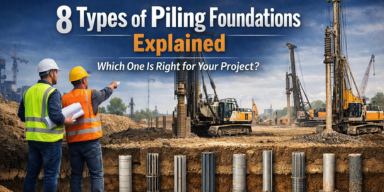
8 Types of Piling Foundations Explained – Which One Is Right for Your Project?
In modern construction, piling foundation in civil engineering plays a crucial role when surface soil conditions cannot support the weight of a structure. Whether you're building a high-rise tower, a bridge, or a residential complex on challenging terrain, understanding the types of piling foundations is essential for project success. Professional piling work service providers specialize in implementing these foundation solutions across diverse construction projects.
A piling foundation transfers structural loads to deeper, more stable soil layers or bedrock when shallow foundations are inadequate. This deep foundation piling types system is particularly vital for piling foundation for weak soil conditions, near water bodies, or when constructing heavy structures. Choosing the right piling work service ensures proper installation and long-term structural integrity. In this comprehensive guide, we'll explore eight major pile foundation types and uses to help you make informed decisions for your construction projects.
What Makes Piling Foundations Essential?
Before diving into specific types, it's important to understand why foundation piling methods are necessary:
-
Poor bearing capacity of surface soil
-
Presence of compressible or expansive soil layers
-
High water table conditions
-
Heavy structural loads requiring deep support
-
Construction in seismic zones
-
Protection against soil erosion or scour
8 Types of Piling Foundations Explained
1. End Bearing Pile Foundation
End bearing pile foundation works by transferring the entire structural load through the pile shaft to a strong, hard stratum located at considerable depth. The pile acts like a column, resting on solid rock or dense soil layers.
Best Used For:
-
Structures requiring transfer of loads to bedrock
-
Sites where hard strata exists at moderate depths
-
Heavy industrial buildings and towers
Common Applications: High-rise buildings, transmission towers, and heavy machinery foundations where specialized piling work service ensures accurate installation to bedrock.
2. Friction Pile Foundation
Unlike end bearing piles, friction pile foundation transfers loads through skin friction between the pile surface and surrounding soil. The entire pile length contributes to load-bearing capacity through adhesion and friction.
Best Used For:
-
Deep soft soil deposits without rock layer
-
Marine structures and offshore platforms
-
Sites where end bearing layer is too deep
Common Applications: Bridge piers in river beds, coastal construction, and structures on deep clayey deposits. Professional piling work service teams use advanced equipment for precise friction pile installation.
3. Sheet Pile Foundation
Sheet pile foundation consists of interlocking steel, vinyl, or timber sheets driven into the ground to form a continuous barrier. While primarily used for retaining purposes, they also provide foundation support in specific conditions.
Best Used For:
-
Waterfront structures and cofferdams
-
Temporary or permanent earth retention
-
Basement construction in congested areas
Common Applications: Retaining walls, seawalls, excavation support, and riverbank protection.
4. Bored Piles (Cast-in-Situ Piles)
Bored piles are constructed by drilling a hole into the ground and filling it with concrete. This foundation piling method is ideal when vibration-free installation is required.
Best Used For:
-
Urban construction near existing structures
-
Noise and vibration-sensitive areas
-
Large diameter pile requirements
Common Applications: Metro stations, residential complexes in cities, and projects near heritage structures.
5. Driven Piles (Precast Piles)
Driven piles are prefabricated concrete, steel, or timber piles hammered into the ground using pile-driving equipment. This is one of the most traditional piling foundation for construction methods.
Best Used For:
-
Cohesive soils with moderate bearing capacity
-
Projects requiring quick installation
-
Budget-conscious projects
Common Applications: Highway bridges, warehouse foundations, and port structures.
6. Screw Piles (Helical Piles)
Screw piles feature helical plates welded to a central shaft and are screwed into the ground like a giant screw. This modern technique offers minimal soil disturbance.
Best Used For:
-
Light to medium structural loads
-
Environmentally sensitive sites
-
Temporary structures and extensions
Common Applications: Solar panel arrays, telecommunication towers, and residential additions.
7. Micro Piles (Mini Piles)
Micro piles are small-diameter drilled and grouted piles, typically 100-300mm in diameter. They're excellent for limited-access sites and underpinning existing structures.
Best Used For:
-
Foundation repair and underpinning
-
Restricted access locations
-
Seismic retrofitting projects
Common Applications: Historic building restoration, slope stabilization, and foundation strengthening.
8. Composite Piles
Composite piles combine two or more materials (typically concrete and steel or concrete and timber) to optimize performance and cost. Different sections utilize materials best suited for specific soil conditions.
Best Used For:
-
Marine environments with varying exposure
-
Cost optimization in deep piling
-
Areas with aggressive soil conditions
Common Applications: Jetties, offshore platforms, and coastal infrastructure.
Choosing the Right Piling Foundation for Weak Soil
When dealing with piling foundation for weak soil, several factors determine the best choice:
Soil Conditions: Friction piles work well in soft clays, while end bearing piles are ideal when hard strata exists at depth. For very weak soils extending to great depths, bored piles with enlarged bases often provide the best solution.
Load Requirements: Heavy structures like high-rises typically require end bearing or large-diameter bored piles, while lighter structures can utilize friction piles or screw piles.
Environmental Constraints: In noise-sensitive areas, bored piles are preferable to driven piles. Near water bodies, sheet piles combined with structural piles offer complete solutions.
Budget Considerations: Driven piles generally cost less than bored piles, but site conditions may dictate the more expensive option for safety and performance.
Comparison: Deep Foundation Piling Types
|
Pile Type |
Installation Method |
Best Soil Condition |
Load Transfer |
|
End Bearing |
Driven/Bored |
Weak soil over rock |
Through tip |
|
Friction |
Driven/Bored |
Deep soft deposits |
Through shaft |
|
Sheet Pile |
Driven |
Any (retaining) |
Lateral support |
|
Bored |
Drilled |
Any |
Combined |
|
Driven |
Hammered |
Cohesive soils |
Combined |
|
Screw |
Screwed |
Stable soils |
Combined |
|
Micro |
Drilled/Grouted |
Any |
Through grout |
|
Composite |
Various |
Variable |
Combined |
Practical Applications of Foundation Piling Methods
Understanding pile foundation types and uses becomes clearer through real-world examples:
Urban High-Rise Projects: Large-diameter bored piles reaching bedrock provide the stability needed for skyscrapers while minimizing disturbance to neighboring buildings.
Bridge Construction: Friction piles in river beds support bridge piers where bedrock is too deep, utilizing skin friction through soft river deposits.
Waterfront Development: Sheet piles create cofferdams for dry construction areas, while driven or bored piles support the permanent structure.
Industrial Facilities: End bearing piles on rock provide the rigid support required for heavy machinery and equipment foundations.
Selecting a Reliable Piling Work Service Provider
When implementing any of these foundation piling methods, partnering with an experienced piling work service company is crucial. A professional service provider brings:
-
Advanced piling equipment and technology
-
Experienced engineers and certified operators
-
Quality assurance and safety compliance
-
Soil testing and foundation design expertise
-
Timely project execution and cost management
Look for piling work service providers with proven track records in projects similar to yours, proper licensing, and comprehensive insurance coverage.
Conclusion: Selecting Your Ideal Piling Foundation
Choosing among the various types of piling foundations requires careful analysis of soil conditions, structural requirements, environmental constraints, and budget limitations. While end bearing pile foundation provides excellent support when bedrock is accessible, friction pile foundation offers reliable performance in deep soft soil deposits.
For projects requiring piling foundation for construction in challenging conditions, consulting with geotechnical engineers and hiring a reputable piling work service is essential. The right foundation piling methods executed by skilled professionals can mean the difference between a successful project and costly foundation failures.
Whether you're working with piling foundation for weak soil or standard conditions, understanding these eight deep foundation piling types equips you to make informed decisions. Remember that the "best" pile type isn't universal—it's the one that best matches your specific project requirements, soil conditions, and construction constraints.
By selecting the appropriate piling foundation in civil engineering and partnering with qualified piling work service providers, you ensure structural stability, cost-effectiveness, and long-term performance for your construction project.
Popular post
February 08, 2025
Pile Load Testing: Importance, Methods, and Benefits
February 11, 2025
Piling Work Service: The Key to Strong and Stable Foundations
February 18, 2025
What Are Geotechnical Services? A Complete Guide

February 22, 2025
What is a Road Safety Audit & Why is it Important?




April 16, 2025
Types of Material Testing: A Complete Guide for Beginners
February 07, 2026
Top 10 Geotechnical Problems in Construction and Their Solutions

March 31, 2026
Top 5 Pile Load Testing Methods Used in Modern Construction


June 30, 2026
Common Mistakes to Avoid During Pile Load Testing
Need help? Call us Today at+91 7665235528
for inquiries and support. We’re here to assist you.